Snowmobile Ice Safety
Snowmobiling on frozen lakes and rivers is a fun and rewarding experience, and introduces a new dimension to your rides.
Any snowmobile and any snowmobiler can safely ride on the ice, though extra precautions and additional safety gear are recommended as riding on the ice does come with some extra risks. Below is a list of basic safety tips to keep in mind if you’re going to operate your snowmobile on frozen lakes and rivers.
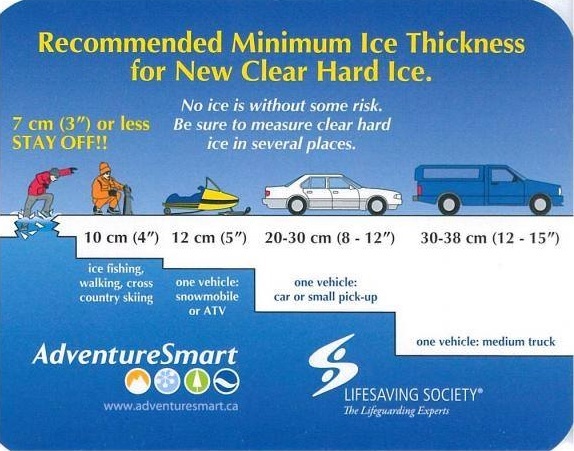
Ice Thickness Chart:
This chart shows some minimum thicknesses for reference. Actual safe thickness will vary depending on many factors, so most organizations recommend waiting until the ice is substantially thicker than the published minimums.
Basic Ice Safety Tips:
- A minimum of 12 cm (5 inches) of good quality ice is needed to operate a snowmobile on it. Waiting until the ice is 25 cm (10 inches) or more is recommended.
- Ice strength varies depending on many factors.
– Clear blue ice is usually good strong ice.
– White or opaque ice is weaker, often about half as strong as blue ice.
– Grey ice and slushy ice should be avoided.
– Ice thickness and quality can vary across a body of water and will be affected by water depth, currents, weather patterns, and other factors. - Before heading out, check ice reports if available.
- If you’re not sure about the ice, don’t go on the ice.
- Wear ice escape picks. A variety of styles are available, and many of them are under $50.
- Consider a floating snowmobile suit.
- Keep distance between each snowmobile, so if ice does give way only one snowmobile will be affected.
- Always be on the lookout for overflow and be ready to avoid it.
- Always travel with rope, pull strap and shovel for safely recovering stuck snowmobiles.
- Always carry some dry clothing to change into in case you get wet.
- Avoid areas where creeks and rivers enter and exit lakes, and other areas known to have a strong current. Ice will usually be significantly thinner in areas with flowing water directly underneath.
- Frozen lakes look like a flat area to play in, but they often have many hard to see hazards such as ice ridges, hard packed snow drifts, ice fishing holes, ice road windrows, etc.
- Snowmobiles can be difficult to steer and take a long time to stop due to the limited traction on ice.
- If you find yourself on thin ice, on open water, or in overflow, DO NOT STOP…
– A slow moving snowmobile will usually sink, while a fast moving snowmobile will often skip across the top.
– Keep up as much momentum as you can and gently steer towards dry land or safer ice.
– Try to keep the front end of the snowmobile up to avoid catching the skis under the ice. - If you fall through, don’t panic.
– Get upright and swim to the edge of the hole.
– Leave your clothing on, air trapped between layers will help you float.
– As you pull yourself out keep your weight as spread out as possible by crawling on your stomach until you’re well away from the open water and back on either strong ice or dry land.
– Immediately proceed to a warm place if there is one nearby, otherwise immediately start a fire and begin warming anyone who got wet. - A snowmobiler through the ice is an emergency, so don’t hesitate to call for help.
- If you’re helping someone else take precautions to ensure you don’t fall in yourself.
– If you end up in the water as well you’ll only make the problem worse.
– Avoid going near the open water and thin ice, instead help from a safe distance by throwing flotation devices and ropes to anyone in the water and pulling them to safety.
– If anyone else is around get their attention and direct them to call for help and begin building a fire at a nearby safe location. - During a Yukon winter it only takes a few minutes for severe hypothermia begin.
– Know the symptoms and be prepared to deal with them.
– Common symptoms of hypothermia are similar to being drunk, and usually include slow reactions, slurred speech, and general clumsiness.
– To avoid serious long term problems or death, getting out of the water and getting warm and dry again fast is absolutely critical.

Overflow
Overflow often occurs on many of the Yukon’s lakes. When snowmobiles encounter overflow it’s very easy to get stuck. There is usually little danger of falling through the main ice layer, however you will likely get wet trying to get unstuck.
Water expands 11% when it freezes, and most lakes freeze from the top down. As the ice freezes lower and lower, this expansion increases the water pressure causing some of the remaining liquid water to push up and out of any available path to the surface. The weight of the ice and snow sitting on top of the liquid water also causes this push. Overflow can happen in virtually any weather.
Once on top of the main ice layer the water mixes with snow and turns to slush, which can quickly bog down a snowmobile. Once this slush gets into your undercarriage it tends to re-freeze making your snowmobile difficult to move and much heavier to lift.
Snowmobilers should always be on the lookout for overflow and be ready to avoid it. If you do encounter overflow keep up your momentum and vacate the area as soon as possible. Always travel with a buddy, carry some recovery equipment, and be ready to light a fire to dry out your wet boots.
More Information:
Safe Riders program ice section: http://www.saferiderssafetyawareness.org/snowmobiling-and-ice.html
Yukon Department of Environment overflow tips and tricks video: https://www.youtube.com/watch?v=zofyktmpYto